
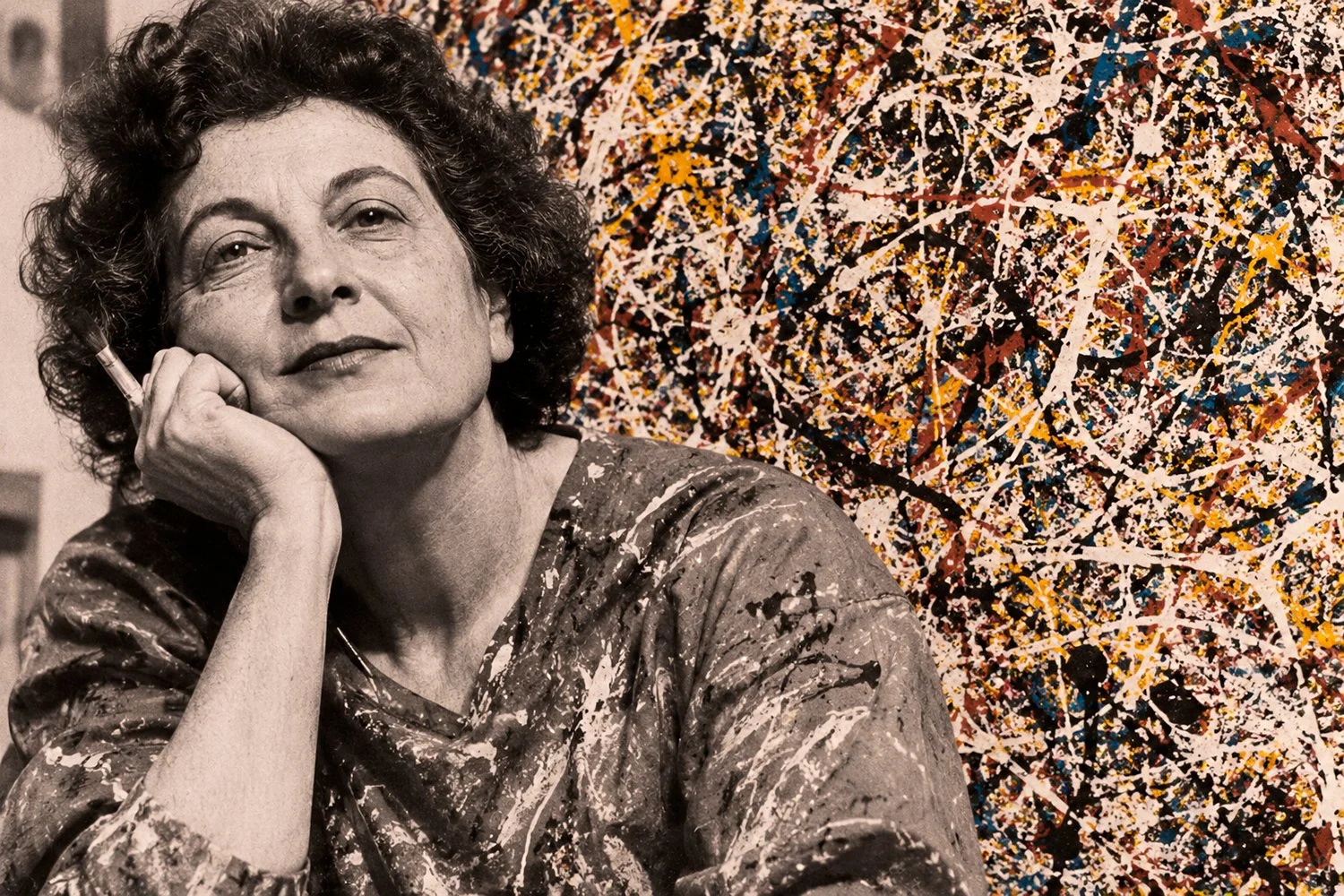
Janet Sobel (1893–1968). AI-generated illustration inspired by historical photographs of the artist, including photography attributed to Ben Schnall, circa 1944.
I have had the opportunity, several times in the United States, to mention the CIA's cultural program during the Cold War and its connection to the extraordinary rise and international promotion of American Abstract Expressionism—Pollock, Rothko, de Kooning and others. The reaction has often surprised me.
People have laughed, dismissed the story, or occasionally insulted me—the “stupid Frenchman,” along with a few less elegant names from the bird kingdom—as though I were repeating some absurd conspiracy theories.
What is interesting is that I have never encountered this reaction outside the United States. In Europe and elsewhere, this history is hardly a secret. It has been documented, researched and discussed for decades. It belongs, quite simply, to the general cultural history of the USA and the Cold War. And most importantly: the CIA itself has acknowledged and documented its covert involvement in this cultural struggle.
So, during the Cold War, culture itself became a battlefield. And this is not speculation discovered decades later. The CIA itself now publicly documents its covert involvement in the cultural Cold War. It secretly supported the Congress for Cultural Freedom, created in 1950, which developed an enormous international network of magazines, exhibitions, conferences, writers and intellectuals. The purpose was not simply to promote some vague idea of “Western culture.” It was part of an American Cold War strategy to present the United States—particularly to European intellectual and cultural circles—as a country of artistic freedom, individual expression and experimentation, in contrast to the state-controlled cultural system of the Soviet Union.
This distinction is important: there is no need to claim that the CIA invented Jackson Pollock, paid him to paint, or created Abstract Expressionism. The documented story is more subtle. American modern art became extremely useful in the cultural struggle of the Cold War, and institutions helped present this new image of the United States internationally.
Jackson Pollock, Mark Rothko, Willem de Kooning and others could represent something America wanted the world to see: a new American culture—independent, experimental, modern and free from official artistic doctrine. But there is another part of this history that deserves much more attention.
Before Pollock became famous for his drip paintings, there was Janet Sobel. Sobel was born Jennie Lechovsky in 1893 near what is today Dnipro, Ukraine. She emigrated to the United States and began making art remarkably late in life. By the 1940s, she was already pouring, dripping and splattering paint across the entire surface of her canvases. And here again, we do not have to speculate about Pollock's connection to her. MoMA documents Sobel's Ukrainian origins and records that the influential critic Clement Greenberg remembered seeing her paintings with Pollock—and that Pollock acknowledged that Sobel's work had made an impression on him.
That is an extraordinary piece of art history.
Pollock became one of the great icons of twentieth-century American art. Janet Sobel, the Ukrainian-born woman whose experiments with poured and dripped paint preceded his celebrated drip paintings, largely disappeared from the dominant narrative for decades.
Then there is Mark Rothko. Rothko was not born in America. He was born Marcus Rothkowitz in Dvinsk in 1903, then part of the Russian Empire and today Daugavpils, Latvia. His family emigrated to the United States when he was a child. So there is a remarkable contradiction at the center of the story. What eventually became celebrated around the world as a triumph of American modern art was created to a significant degree by immigrants and outsiders—people carrying with them the memories, upheavals and cultural inheritance of Europe and Eastern Europe. Pollock himself was American-born, but one of the artists whose work preceded and influenced his development was a Ukrainian-born immigrant woman. Rothko was an immigrant from the Russian Empire.
De Kooning arrived from the Netherlands. And during the Cold War, their work became part of an international projection of American cultural freedom.
The CIA's covert cultural program is documented history.
Janet Sobel's Ukrainian origins are documented history.
Pollock's exposure to Sobel's work is documented history.
Rothko's origins in Dvinsk—today Daugavpils, Latvia—are documented history.
None of this diminishes Pollock or Rothko as artists. It makes history richer. The artists created the art. But governments, museums, critics, collectors and cultural institutions understood that art could also become an extraordinarily powerful instrument of international influence.
During the Cold War, Pollock could communicate something without depicting a flag, a president or a political slogan.
It could simply say: This is what American freedom looks like.
And somewhere behind the famous image of Pollock dripping paint across a canvas stands Janet Sobel, a Ukrainian-born woman who was doing it before him.
She deserves to be remembered.