
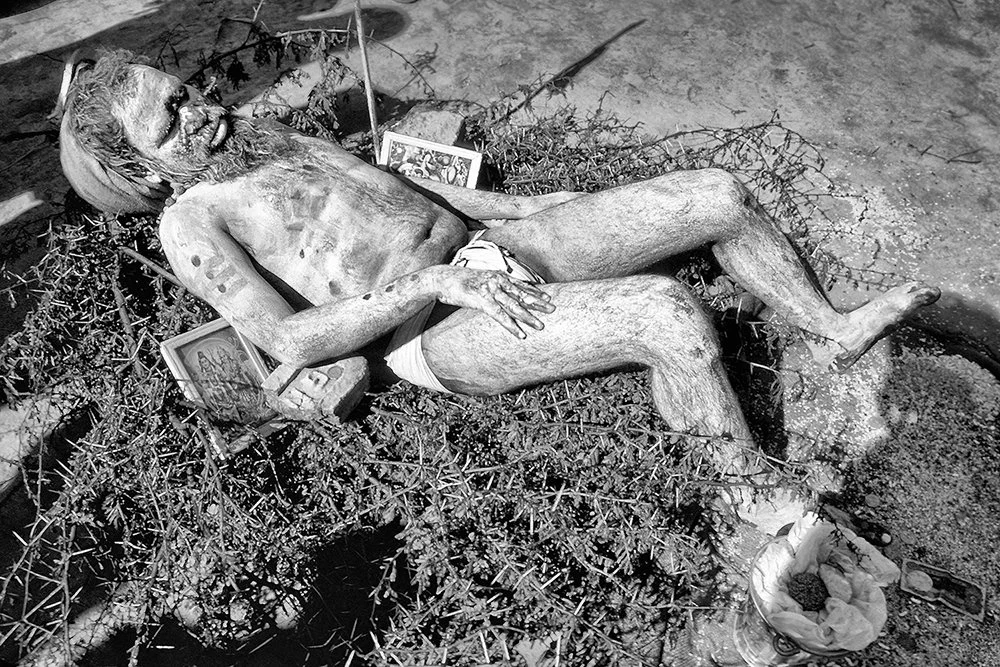
Naga Sadhu practising penance, Maha Kumbh Mela, Allahabad, India, 1989. © Pierre Toutain-Dorbec
In 1989, I returned to Allahabad to photograph the Maha Kumbh Mela. It was my third Maha Kumbh. My work there focused principally on the lives of the Naga Sadhus and on the problems faced by people affected by leprosy, in collaboration with the Bombay Leprosy Project.
Tens of millions of pilgrims gathered over the course of the festival. Yet within that immense gathering, a photograph could bring attention back to one person: a face, a gesture, a body resting on thorns.
At the meeting of three rivers
Allahabad, officially renamed Prayagraj in 2018, stands beside a place long revered as Prayag. Here, at the Triveni Sangam, the Ganges and Yamuna meet. A third river, the Saraswati, is believed in Hindu tradition to join them invisibly beneath the surface.
Two rivers can be seen; the third is present through faith. For pilgrims, this confluence is a sacred place where bathing carries the promise of purification. It gives the gathering its spiritual centre, drawing people from across India to the riverbanks.
Photographing the Naga Sadhus
I was there largely to document the lives of the Naga Sadhus, ascetics whose practices involve renunciation and bodily discipline. Their presence is an essential part of the Kumbh, but the subject extends beyond the great processions and ceremonial bathing.
The photograph accompanying this article shows a Naga Sadhu reclining on a bed of thorn branches. His body lies diagonally across the frame. Small devotional pictures rest beside him. The branches form a dense, sharp network beneath his back and limbs.
The thorns immediately attract the eye. Looking longer, other details emerge: the position of his hands, his expression, the objects within reach. These details give the photograph its particularity. It records an individual within a religious practice, while leaving much of his life outside the frame.
A photograph can show the physical circumstances of an act of penance. It cannot, by itself, explain what that act means to the person undertaking it. That requires listening, context, and an acceptance of the limits of what we understand.
Another part of my work
Alongside this coverage, I was working on the problems of leprosy in collaboration with the Bombay Leprosy Project.
This was a separate strand of my reporting. The photograph shown here documents a Naga Sadhu’s ascetic practice; it does not identify him as someone affected by leprosy.
The Bombay Leprosy Project’s work has addressed care within the community and the stigma surrounding the disease. For a photographer approaching this subject, representation carries its own responsibility. A person’s illness must never become the whole of their identity.
Bringing these subjects into the same account of my time in Allahabad requires care. Religious renunciation and exclusion through illness are different experiences. Each deserves attention on its own terms.
Returning to the photograph
Today, this image remains part of my record of the 1989 Maha Kumbh Mela. It holds a specific place and moment within a gathering too large for any single photograph to encompass.
The festival’s scale belongs to its history. This man’s presence belongs to the photograph.
Looking at it again, I return to the small devotional images beside him, the resting hands, and the thorn branches beneath his body. They invite a slower kind of attention—one that begins with what is visible and leaves room for what the photograph cannot tell us.
Photograph: Naga Sadhu practising penance, Maha Kumbh Mela, Allahabad, India, 1989. © Pierre Toutain-Dorbec.